

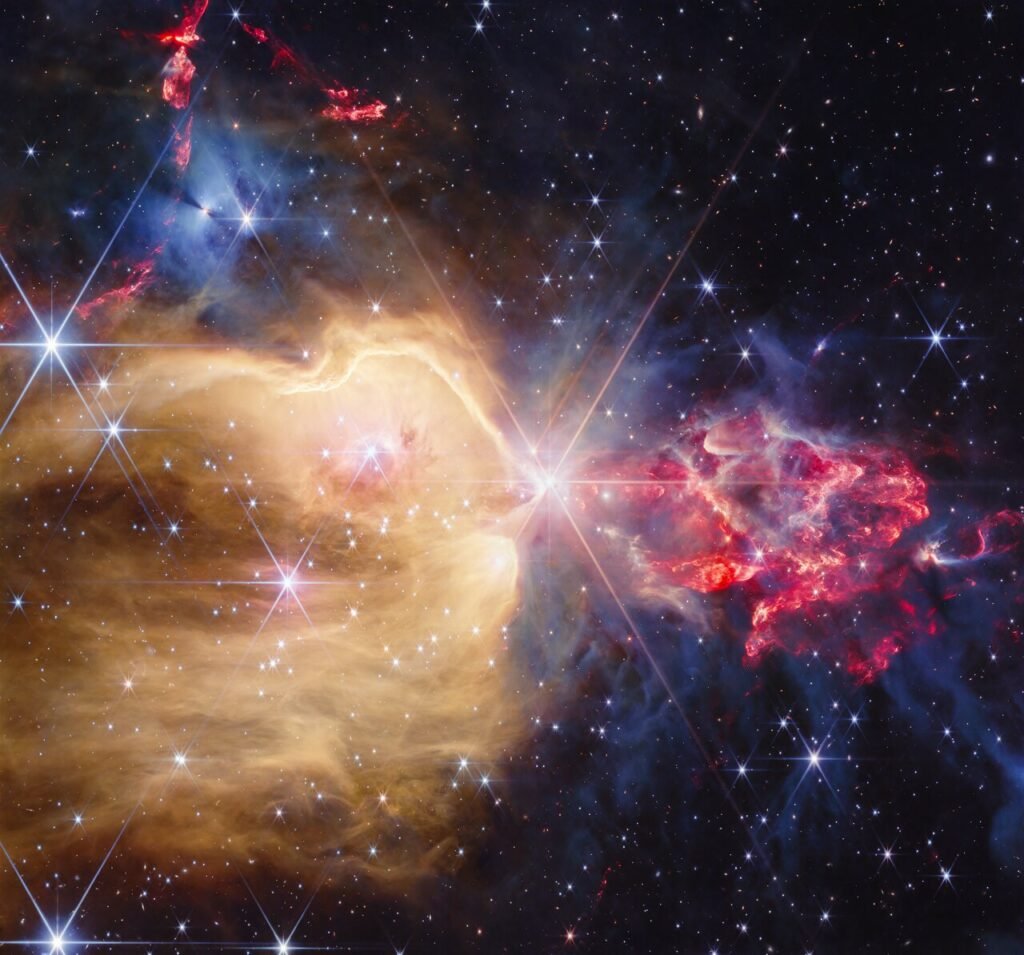
NASA’s Astronomy Picture of the Day on Monday revisits a stellar nursery about 3,300 light-years from Earth. The James Webb Space Telescope’s infrared view of NGC 7129, in the constellation Cepheus, shows young stars and the gas they disturb as they grow. The observation was first released in October.
The scene captures stars at different stages of formation. On one side, comparatively mature young stars heat their surroundings, leaving a region rich in hot atomic hydrogen that appears gold in the processed image. On the other, newer stars still embedded in cooler molecular gas send out jets. Those flows heat the gas they strike, producing red knots and filaments in the image.
NASA’s earlier Spitzer telescope also observed the nursery. Webb’s finer infrared detail shows smaller structures in the dust and gas, helping researchers distinguish where young stars are already reshaping their surroundings and where denser material remains.
El telescopio Webb muestra chorros de estrellas jóvenes en NGC 7129
La Imagen Astronómica del Día de la NASA vuelve este lunes a una región de formación estelar situada a unos 3,300 años luz de la Tierra. La vista infrarroja de NGC 7129, en la constelación de Cefeo, muestra estrellas jóvenes y el gas que alteran a medida que crecen. La observación del telescopio espacial James Webb se divulgó por primera vez en octubre.
La escena recoge distintas etapas de la formación estelar. A un lado, estrellas jóvenes relativamente más desarrolladas calientan su entorno. El resultado es una región rica en hidrógeno atómico caliente que se ve dorada en la imagen procesada. Al otro lado, estrellas aún en formación dentro de gas molecular más frío expulsan chorros que calientan el gas a su paso y aparecen como nudos y filamentos rojos.
El telescopio Spitzer de la NASA también observó esta región. El mayor detalle infrarrojo del Webb permite ver estructuras más pequeñas en el polvo y el gas. Así, los investigadores pueden distinguir dónde las estrellas jóvenes ya modifican su entorno y dónde queda material más denso.
Sources / Fuentes: NASA’s Nov. 16 Astronomy Picture of the Day; ESA/Webb observation and credits.
Photo credit / Crédito fotográfico: NASA, ESA, CSA, STScI; image processing / procesamiento: A. Pagan (STScI); CC BY 4.0 (license / licencia).
About The Author

More Stories
Chicago supercomputing conference opens its exhibit hall Monday
Mojave National Preserve begins work on 42 miles of roads
USGS funds 26 states to preserve geological records and samples