

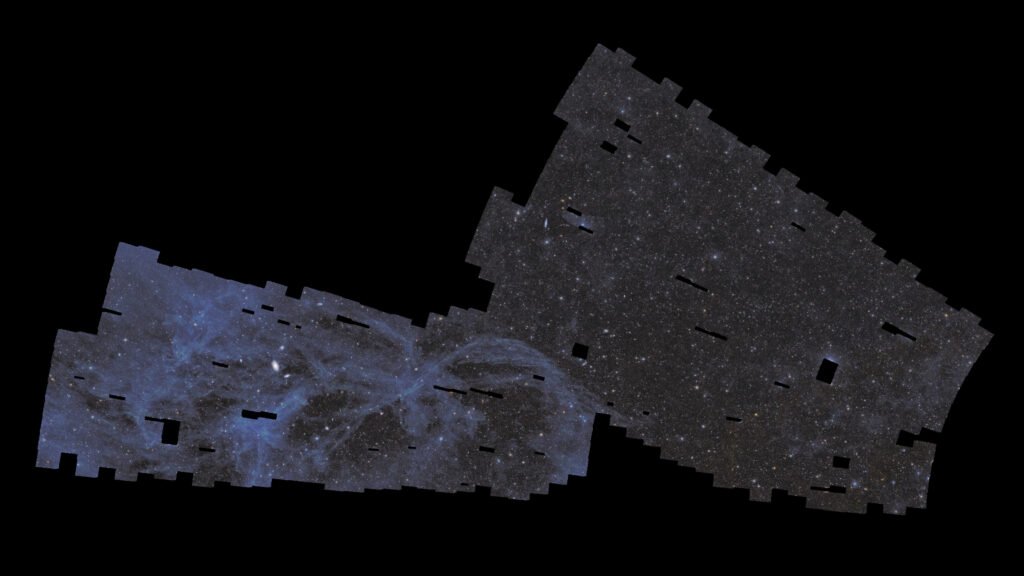
The European Space Agency released the first major batch of data from its Euclid space telescope on Nov. 12. The release, called DR1-Foundation, draws on about 13 months of observations. ESA says the telescope captured light from more than a billion objects across an area of sky equivalent to roughly 9,500 full moons.
The release includes images and spectra, which show how light is distributed across wavelengths. Scientists will use those observations to start building a three-dimensional map of the universe and to study the effects of dark matter and dark energy. One mosaic combines 740 observations of the northern sky; it includes the spiral galaxy Messier 81, about 12 million light-years from Earth.
Euclid capta la luz de más de mil millones de objetos en su primera gran publicación de datos
La Agencia Espacial Europea publicó el 12 de noviembre el primer gran conjunto de datos de su telescopio espacial Euclid. La entrega, denominada DR1-Foundation, reúne unos 13 meses de observaciones. Según la agencia, Euclid captó la luz de más de mil millones de objetos en una región del cielo equivalente a unas 9,500 lunas llenas.
La publicación incluye imágenes y espectros, que muestran cómo se distribuye la luz entre distintas longitudes de onda. Con esas observaciones, el equipo científico comenzará a construir un mapa tridimensional del universo y a estudiar los efectos de la materia y la energía oscuras. Uno de los mosaicos reúne 740 observaciones del cielo del hemisferio norte e incluye a Messier 81, una galaxia espiral a unos 12 millones de años luz de la Tierra.
Photo credit / crédito de imagen: ESA/Euclid/Euclid Consortium/NASA, image processing by J.-C. Cuillandre and E. Bertin · CC BY-SA 3.0 IGO · ESA’s downloadable version, no intentional crop.
About The Author




More Stories
Jalisco’s Mascota brings mariachi to its main square Nov. 21
Halifax Citadel brings back its Victorian Christmas weekend
Thailand’s Loi Krathong celebrations build toward the November full moon