

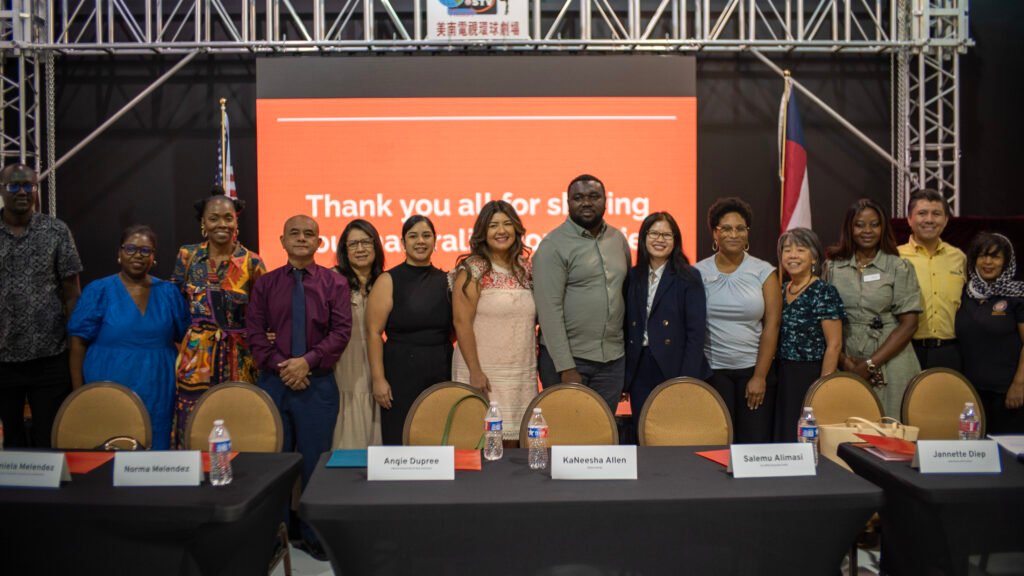
A Day of Citizenship and Storytelling
In a city built on diversity, a coalition of community leaders, educators, and advocates is working to transform how immigrants view the path to citizenship. It is no longer seen only as a complex process, but as an act of empowerment. On National Citizenship Day, Houston Community Media hosted a gathering that brought together local organizations and families to share stories of perseverance and hope under the banner “Naturalize Now, Houston!”
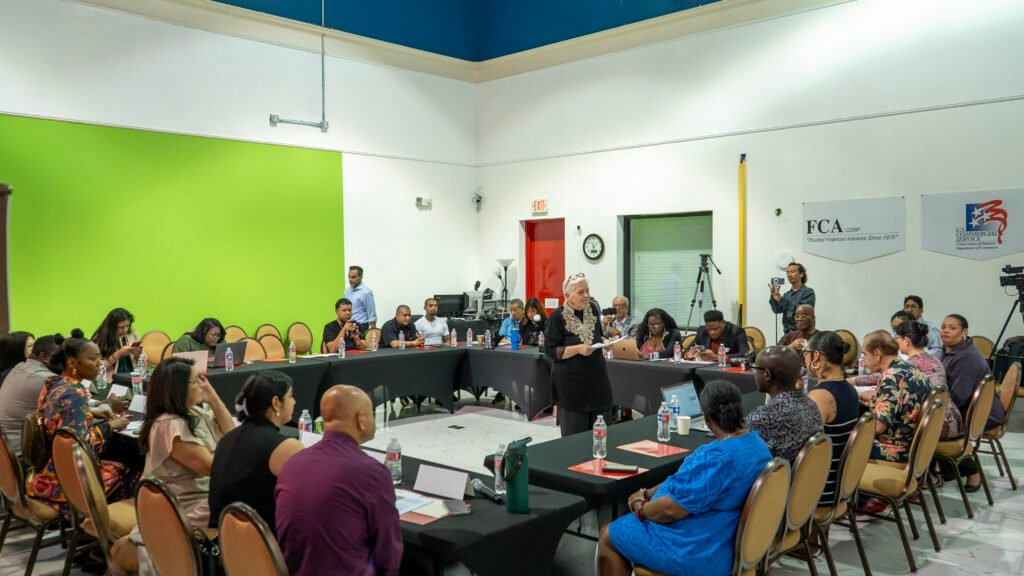
For many in the audience, the message was both urgent and deeply personal. Narrator Sandy from Houston Community Media reminded the group, “We can’t afford to be passive anymore. Citizenship is a way of ensuring safety for ourselves and our families.” The event became a living illustration of that sentiment, filled with stories that reflected both fear and courage, struggle and belonging.
Building Trust Through Action
The initiative, launched in October 2023, is led by the National Partnership for New Americans. Its Citizenship Coordinator, Angie Dupree, explained that the effort relies on three pillars: the Community Navigator model, partnerships with Harris County and the City of Houston, and strategic communications.
“We’re building trust amid fear, confusion, and disinformation,” Dupree said. “Our website hosts a calendar of naturalization workshops, citizenship classes, and events. It’s important that the city and community work together to build that trust.” Dupree, a proud Houstonian and daughter of Mexican immigrant parents, has built her career helping families like her own navigate the path from green card holder to citizen.
The Melendez Family’s Journey to Citizenship
Trust and persistence were at the heart of one of the afternoon’s most moving moments, the story of the Melendez family. Daniela Melendez, who works as a community and hotline operator at the Houston Immigration Legal Services Collaborative, introduced her parents, Manuel and Norma. Together, they shared their 25-year journey from El Salvador to U.S. citizenship.
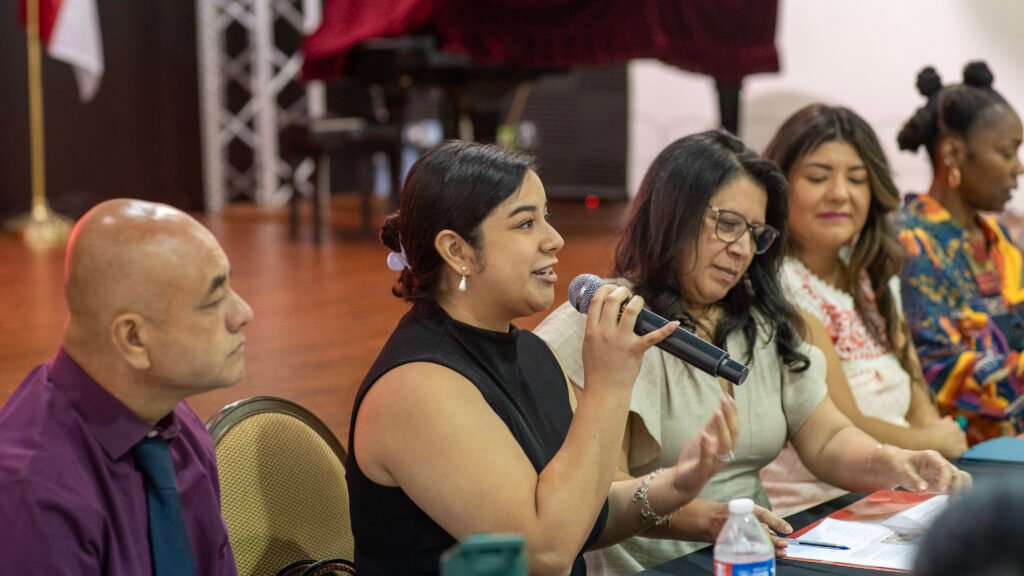
“When we arrived, there was an earthquake in El Salvador, and we were granted Temporary Protected Status,” Manuel recalled. “For 15 years we renewed TPS. In 2016, we applied. It was a fast process. I applied in January, my interview was in March, and I did my oath ceremony in May.” Norma, who spent her career caring for children and the elderly, added, “I took civics classes at the YMCA, and a lawyer from BPSOS helped review our application. My interview was June 9, and my oath ceremony was August 20. Now I’m continuing to learn English.”
Their daughter Daniela said the urgency to naturalize came from the uncertainty of recent years. “Even lawful permanent residents can still be subject to immigration actions or state laws,” she said. “Citizenship is the safest status. My message to others is, keep going, do it now. It’s worth it; then you can vote.”
Designing Support Systems for Immigrant Communities
From there, the event turned to the partnerships making these stories possible. KaNeesha Allen, Community Collaboration Lead with Dalberg Design, has helped coordinate the city’s pilot programs supported by the Houston Endowment. Her work involves human-centered design that listens to immigrant communities to create solutions based on their needs. “We centered immigrant voices,” she said. “Our pilot programs included a Citizenship Support Circle, a five-part workshop series, and a Community Navigator program for those ready to apply but needing help connecting to legal aid or completing applications.”
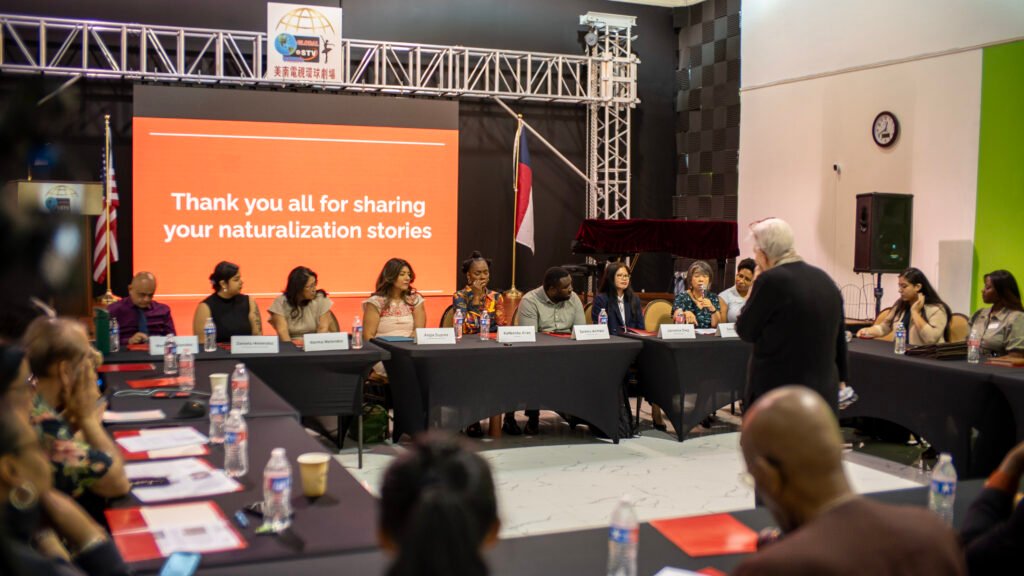
Navigators and the Power of Conversation
For Jannette Diep, Executive Director of Boat People SOS Houston, trust begins with conversation. “The navigator piece was crucial,” she said. “Through the support circles we met people who wanted to apply but had worries, especially with new policies. Sitting with them, answering questions, helped them feel ready.”
Unity Within Diversity
Salemu Alimasi, Executive Director of the CO AFRO Community Center, echoed that sentiment from his work with African refugee and immigrant communities. “Trust is everything,” he said. “People hesitate because of language barriers or fear. We explain in their language so they understand the benefits and feel safe to move forward. When trust is there, people are ready.”
Confidence, Education, and Community Support
At the Literacy Council of Fort Bend County, Adult Education Director Ashley Borjon described how literacy and confidence are deeply connected. “We serve adults 18 and older. The main barrier wasn’t just language, it was confidence,” she said. “Participants in their 60s asked, ‘Can I remember the information? Can I communicate in English?’ We saw how encouragement and peer support changed that.”
Representing Engage Houston, AJ added that many green card holders delay applying out of fear of language tests, background checks, or fees. “Engage can help with fee support and screening concerns,” he said. “We’ve worked on this two to three years with support from partners here.”
Policy, Protection, and the Road Ahead
The discussion closed with Zenobia Lai, Executive Director of HILSC, who offered both encouragement and caution. “Citizenship is good. Eligible people should take that step,” she said. “But millions still have no line to citizenship. About 1.4 million have Temporary Protected Status, and 700,000 are DACA recipients. Congress has not acted in 25 years to give them a path.”
Lai also warned of evolving challenges, including potential changes to the civics exam and shifting interpretations of “good moral character.” “Officers may now look beyond the last five years and expect positive community contributions,” she said. “We are also seeing a rise in interview hostility. This underscores the need for accompaniment and preparation.”
A Shared Commitment to Belonging
The event ended with gratitude from Sandy, who thanked the speakers for their leadership and courage. In every story, from families finding their place to organizations building bridges, Houston’s naturalization movement revealed what citizenship truly means: a commitment to trust, belonging, and a shared future.
Updated Civics Exam Questions:
El Impulso de Houston por la Naturalización: Historias de Esperanza, Confianza y Pertenencia
Un Día de Ciudadanía y Narración
En una ciudad construida sobre la diversidad, una coalición de líderes comunitarios, educadores y defensores trabaja para transformar la forma en que los inmigrantes ven el camino hacia la ciudadanía. Ya no se trata solo de un proceso complejo, sino de un acto de empoderamiento. En el Día Nacional de la Ciudadanía, Houston Community Media organizó un encuentro que reunió a organizaciones locales y familias para compartir historias de perseverancia y esperanza bajo el lema “¡Naturalízate Ahora, Houston!”.
Para muchos en la audiencia, el mensaje fue urgente y profundamente personal. La narradora Sandy, de Houston Community Media, recordó al grupo: “Ya no podemos darnos el lujo de ser pasivos. La ciudadanía es una forma de garantizar seguridad para nosotros y nuestras familias.” El evento se convirtió en una representación viva de ese sentimiento, lleno de historias que reflejaron tanto el miedo como el valor, la lucha y la pertenencia.
Construyendo Confianza a Través de la Acción
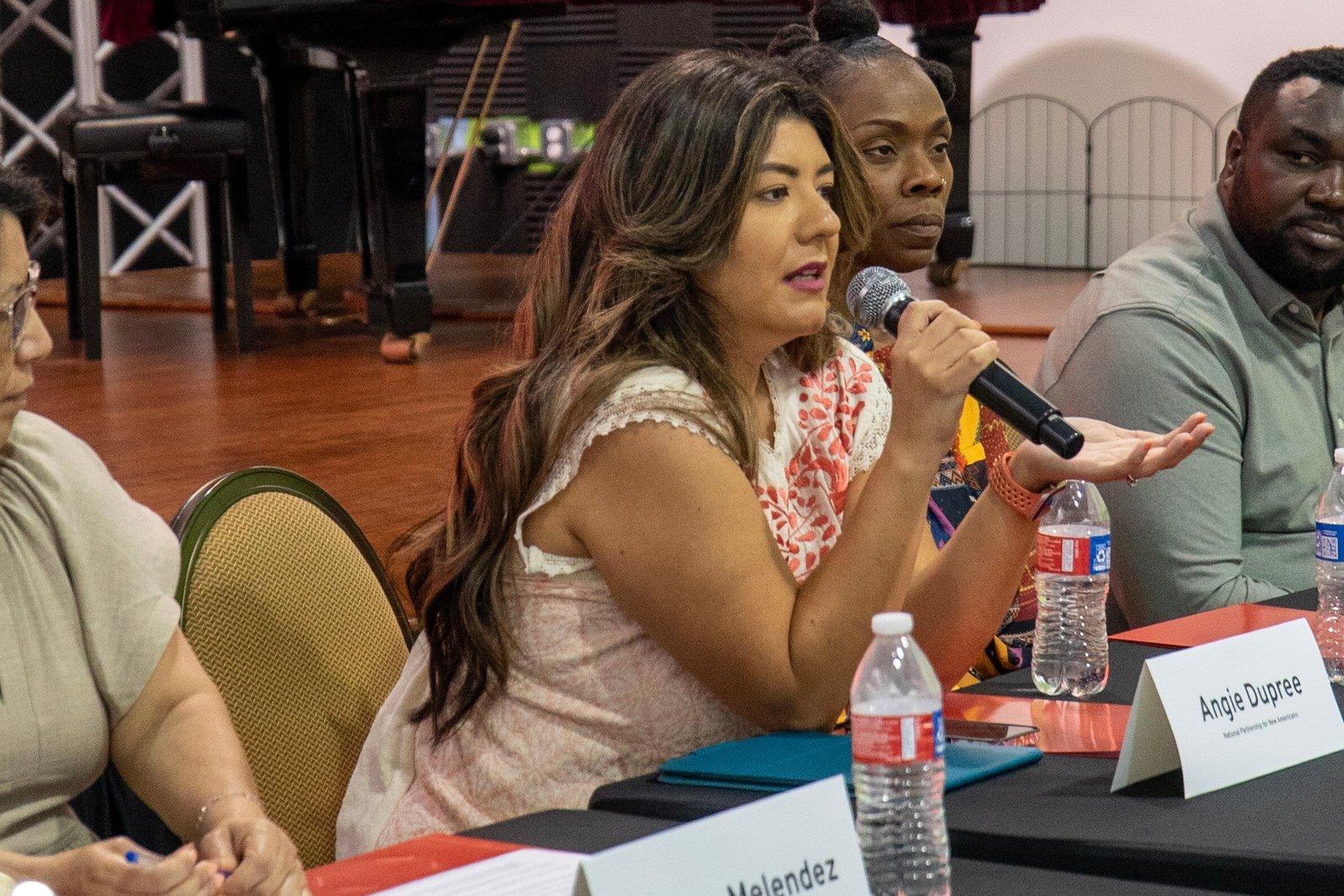
La iniciativa, lanzada en octubre de 2023, está dirigida por la National Partnership for New Americans (NPNA). Su Coordinadora de Ciudadanía, Angie Dupree, explicó que el esfuerzo se basa en tres pilares: el modelo de Navegadores Comunitarios, las alianzas con el Condado de Harris y la Ciudad de Houston, y la comunicación estratégica. “Estamos construyendo confianza en medio del miedo, la confusión y la desinformación,” dijo Dupree. “Nuestro sitio web tiene un calendario de talleres de naturalización, clases de ciudadanía y eventos. Es importante que la ciudad y la comunidad trabajen juntas para crear esa confianza.” Dupree, orgullosa hija de padres inmigrantes mexicanos, ha dedicado su carrera a ayudar a familias como la suya a avanzar desde la residencia permanente hasta la ciudadanía.
La Historia de la Familia Meléndez
La confianza y la perseverancia fueron el corazón de uno de los momentos más conmovedores de la tarde: la historia de la familia Meléndez. Daniela Meléndez, quien trabaja como operadora comunitaria y de línea directa en el Houston Immigration Legal Services Collaborative (HILSC), presentó a sus padres, Manuel y Norma. Juntos compartieron su recorrido de 25 años desde El Salvador hasta convertirse en ciudadanos estadounidenses.
“Cuando llegamos hubo un terremoto en El Salvador y nos otorgaron el TPS, Estatus de Protección Temporal,” recordó Manuel. “Durante 15 años lo renovamos. En 2016 aplicamos. Fue un proceso rápido. Apliqué en enero, mi entrevista fue en marzo y tuve mi ceremonia de juramento en mayo.” Norma, quien dedicó su vida al cuidado de niños y adultos mayores, agregó: “Tomé clases de educación cívica en el YMCA y una abogada de BPSOS revisó nuestra solicitud. Mi entrevista fue el 9 de junio y mi ceremonia de juramento el 20 de agosto. Ahora sigo aprendiendo inglés.”
Su hija Daniela explicó que la urgencia de naturalizarse vino de la incertidumbre de los últimos años. “Incluso los residentes permanentes legales pueden estar sujetos a acciones migratorias o leyes estatales,” dijo. “La ciudadanía es el estatus más seguro. Mi mensaje para otros es: sigan adelante, háganlo ahora. Vale la pena, y luego pueden votar.”
Diseñando Sistemas de Apoyo para las Comunidades Inmigrantes
El evento también destacó las alianzas que hacen posibles estas historias. KaNeesha Allen, líder de colaboración comunitaria en Dalberg Design, ayudó a coordinar los programas piloto de la ciudad con el apoyo de la fundación Houston Endowment. Su trabajo se basa en el diseño centrado en las personas, escuchando las voces inmigrantes para crear soluciones basadas en sus necesidades. “Pusimos las voces de los inmigrantes en el centro,” explicó. “Nuestros programas piloto incluyeron un Círculo de Apoyo a la Ciudadanía, una serie de cinco talleres, y un programa de Navegadores Comunitarios para quienes necesitaban ayuda legal o asistencia con las solicitudes.”
Navegadores y el Poder de la Conversación
Para Jannette Diep, directora ejecutiva de Boat People SOS Houston, la confianza comienza con la conversación. “La parte de los navegadores fue crucial,” dijo. “A través de los círculos de apoyo conocimos a personas que querían aplicar pero tenían preocupaciones, especialmente con las nuevas políticas. Sentarnos con ellos y responder a sus preguntas los ayudó a sentirse listos.”
Unidad Dentro de la Diversidad
Salemu Alimasi, director ejecutivo del CO_AFRO Community Center, compartió una visión similar basada en su trabajo con comunidades africanas de refugiados e inmigrantes. “La confianza lo es todo,” afirmó. “La gente duda por las barreras del idioma o el miedo. Les explicamos en su propio idioma para que entiendan los beneficios y se sientan seguros. Cuando hay confianza, la gente está lista.”
Confianza, Educación y Apoyo Comunitario
En el Consejo de Alfabetización del Condado de Fort Bend, la directora de educación para adultos Ashley Borjon habló sobre cómo la alfabetización y la confianza están profundamente conectadas. “Atendemos a adultos mayores de 18 años. El principal obstáculo no era solo el idioma, sino la confianza,” explicó. “Participantes de más de 60 años se preguntaban: ¿Puedo recordar la información? ¿Puedo comunicarme en inglés? Vimos cómo el apoyo y el ánimo entre compañeros cambiaron eso.”
Representando a Engage Houston, AJ añadió que muchos residentes con tarjeta verde retrasan su solicitud por miedo a los exámenes de inglés, a los antecedentes o a las tarifas. “Engage puede ayudar con apoyo financiero y revisión de antecedentes,” dijo. “Hemos trabajado en esto durante dos o tres años con el apoyo de los socios aquí presentes.”
Política, Protección y el Camino por Delante
El cierre del evento estuvo a cargo de Zenobia Lai, directora ejecutiva de HILSC, quien ofreció tanto ánimo como advertencia. “La ciudadanía es buena. Las personas elegibles deberían dar ese paso,” dijo. “Pero millones aún no tienen un camino hacia la ciudadanía. Unos 1.4 millones tienen Estatus de Protección Temporal, y 700 mil son beneficiarios de DACA. El Congreso no ha actuado en 25 años para ofrecerles una vía.”
Lai también advirtió sobre los desafíos que evolucionan, incluidos los posibles cambios en el examen cívico y las nuevas interpretaciones de ‘buen carácter moral’. “Los oficiales ahora pueden revisar más allá de los últimos cinco años y esperar contribuciones comunitarias positivas,” explicó. “También estamos viendo un aumento en la hostilidad durante las entrevistas. Esto demuestra la necesidad de acompañamiento y preparación.”
Un Compromiso Compartido con la Pertenencia
El evento concluyó con palabras de agradecimiento de Sandy, quien reconoció el liderazgo y el valor de los oradores. En cada historia, desde las familias que encontraron su lugar hasta las organizaciones que construyen puentes, el movimiento de naturalización de Houston mostró lo que realmente significa la ciudadanía: un compromiso con la confianza, la pertenencia y un futuro compartido.
About The Author

More Stories
United Way of Greater Houston Highlights Lifeline Impact of 211 During Annual Awareness Event
Reclaiming Community Narratives as America Nears Its 250th Anniversary
Housing Stability in Houston Takes Center Stage at Houston Community Media Briefing