

Texas is once again at the center of a fierce political battle over redistricting. In early August, Governor Greg Abbott and Republican leaders unveiled plans to redraw congressional maps ahead of the 2026 midterm elections, only three years after maps were redrawn following the 2020 census. Supporters argue the changes are legal and will maximize voter choice. Opponents say they represent an unprecedented power grab that will disenfranchise Black, Latino, and Asian voters while cementing Republican dominance for years to come.
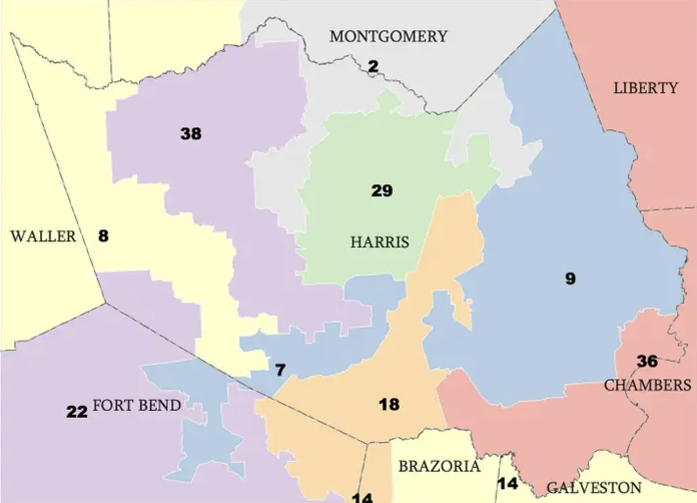
The move has been called a “redistricting war,” drawing in lawmakers, attorneys, and grassroots activists from across the state. Recent public testimony highlighted the stakes for minority communities in Greater Houston and across Texas.
A Walkout in Protest
On August 3, dozens of Democratic legislators staged a dramatic walkout from the Texas House to prevent a quorum, effectively halting the special session convened to consider the new maps. The move also froze other pending measures, including flood relief.
Governor Abbott and Attorney General Ken Paxton responded by petitioning the Texas Supreme Court to remove legislators who abandoned their seats. State Representative Gene Wu, one of the leading figures in the walkout, has since lived out of hotels outside Texas to avoid arrest.
Republicans defend the maps as consistent with Supreme Court precedent allowing partisan but not racial gerrymandering. Democrats counter that the proposals are racially discriminatory, violating the Voting Rights Act by cracking, packing, and diluting minority districts.
Representative Gene Wu: “Our Voices Are Being Silenced”
Wu opened with a blunt warning: “Gerrymandering is cheating, plain and simple. They are rewriting the rules in the middle of the game because they know they are going to lose.”
He noted that redistricting is supposed to happen only once a decade following the census. Texas completed its post-2020 redistricting just three years ago, and those maps are still under court review. “The decision has not even come down yet,” Wu emphasized. “And already, they want to redraw again.”

Wu pointed out that minority populations drove nearly all of Texas’ growth between 2010 and 2020, yet the two new congressional seats awarded to the state after the census were majority white. “How did that happen?” he asked. “This is racial gerrymandering, turbocharged.”
He explained that Republicans are using two main tactics: cracking, which splits large minority communities into several districts, and packing, which concentrates minority voters into one supermajority district that prevents influence elsewhere.
“These manipulations mean that if you are Latino in Texas, your vote could count as one-third of a white vote. If you are Black, one-fifth,” Wu said. “That is unconstitutional, immoral, and deadly. If we cannot advocate for services, funding does not come. And when money does not come, people die.”
Karla Maradiaga: “Democracy Turned Upside Down”
Karla Maradiaga, a voting rights attorney with the Texas Civil Rights Project, underscored the legal fight ahead. She recalled attending a Houston redistricting hearing where nearly 1,000 residents signed up to testify against the maps.
“It was emotional to see that turnout,” she said. “But the community had no maps to review. There was no transparency. People were testifying blindly, without details, and still they showed up in force.”

Maradiaga highlighted how the process prioritized political maneuvering over urgent community needs. Flood relief, long promised by state leaders, was sidelined in favor of redistricting. “When representatives choose their voters instead of voters choosing representatives, accountability vanishes. That turns democracy upside down,” she said.
Her organization has already filed lawsuits challenging the maps in Tarrant County, where Republicans dismantled a majority-minority district that had elected Black Commissioner Simmons. Now, in a majority-minority county, only one of five commissioners is from a minority background.
“This is how power is stolen,” Maradiaga said. “And it is why we fight.”
Melissa Ayala: “A Box that Silences Us”
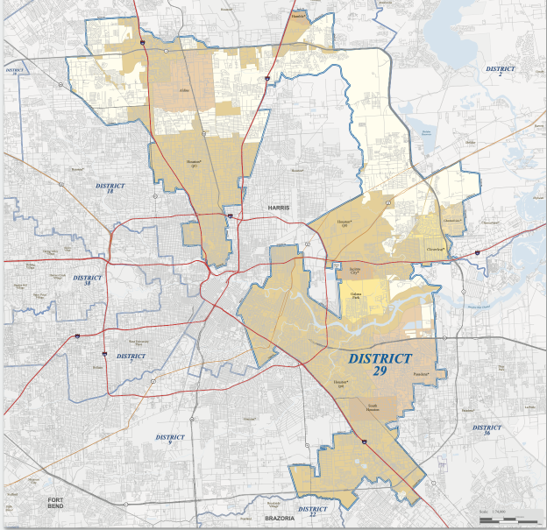
For residents, the changes feel deeply personal. Melissa Ayala, a longtime activist and two-time census worker, described how her own home district, Congressional District 29, has been transformed.
Currently, District 29 resembles a backward “C,” encompassing South Houston, Pasadena, Jacinto City, and Aldine. It is 74 percent Latino and overwhelmingly working-class. Under the new maps, however, the district becomes a compact box, shedding key neighborhoods and importing new ones.
“The shift reduces the percentage of Democratic-leaning Latino voters,” Ayala explained. “It favors Republicans while still keeping Latinos inside the boundaries, but in diluted form.”
She pointed to exit polls from 2024 showing a rightward shift among Latino voters, something Republicans are now trying to exploit. “They are targeting us because we are seen as in play,” Ayala said.
Still, she acknowledged the difficulty of keeping redistricting at the forefront for working families facing inflation, high grocery costs, and soaring car prices. “People think about the now, food, rent, bills. Not five years down the line,” she said. “But with social media, people are more aware of redistricting than ever before.”
Carmela Walker: “The Stakes for Black Voters”
Carmela Walker of the Houston Area Urban League addressed what is at stake for African American communities. “Packing and cracking Black districts is nothing new,” she said. “But these maps take it to extremes, muting our voices in Houston and across Texas.”
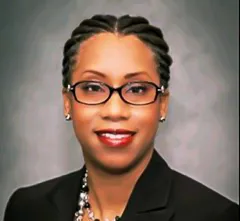
Walker warned that reducing Black representation means not only fewer elected leaders but also fewer advocates for issues ranging from healthcare access to criminal justice reform. “When your community is no longer relevant to their re-election, they stop taking your calls. That is the brutal truth,” she said.
Her message was clear: lawsuits matter, hearings matter, but above all, sustained community engagement is essential. “We must show up, vote, and organize, no matter how tired we are,” Walker urged.
National Ripple Effects
Wu warned that the battle in Texas will not remain contained. Already, California lawmakers are considering a “trigger law” that would redraw their own maps if Texas proceeds, creating a domino effect across blue states.
“This is like the Cold War,” Wu said. “If Texas redraws, others will follow. And if every state redraws maps after every election, democracy ends. That is game over.”
He called for a federal solution: a nationwide ban on partisan gerrymandering and the creation of independent redistricting commissions. “Until then, it is trench warfare,” he said.
A Fight for Representation
The hearings made one truth clear. Redistricting is not just about lines on a map, it is about power, resources, and the survival of communities. For Texans of color, who fueled nearly all the state’s growth in the last decade, the stakes are existential.
As Wu put it bluntly: “If we cannot change the future, it is the end of our republic.”
For now, the fight moves to the courts, the streets, and the hearts of voters who must decide whether they will accept maps critics say are designed to silence them, or demand something better.
About The Author


More Stories
United Way of Greater Houston Highlights Lifeline Impact of 211 During Annual Awareness Event
Reclaiming Community Narratives as America Nears Its 250th Anniversary
Housing Stability in Houston Takes Center Stage at Houston Community Media Briefing