

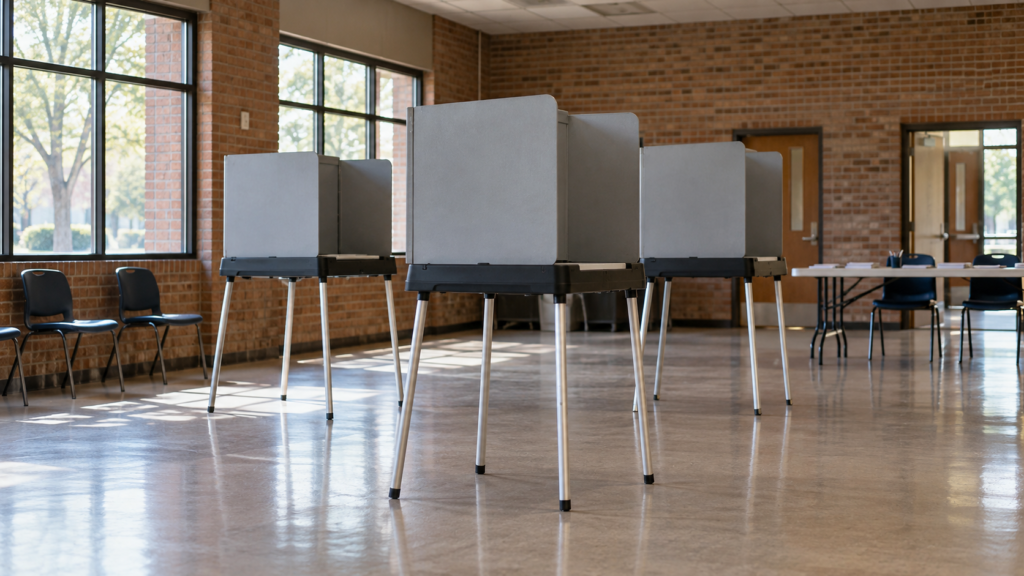
Election coverage should help people feel prepared to vote. That is my biggest takeaway from Houston Community Media’s September 29 briefing with the Texas Civil Rights Project. With the November 3 Texas midterm elections approaching, accurate reporting means explaining deadlines, checking claims and showing readers where to get help. A confusing headline can discourage participation. A clear explanation can give someone the confidence to protect their vote.
Moderator Nakia Cooper opened the training by emphasizing informed, responsible coverage and closed with an urgent reminder to get information into communities quickly. The discussion brought together election law, storytelling and questions that Texans are already asking about registration and accountability.
The Experts Behind the Election Briefing

Carl Blair, the Texas Civil Rights Project’s Senior Election Protection Attorney, led the legal training. He joined the organization in 2022 after running a Houston legal practice and working on advocacy and election protection campaigns. His biography also identifies service on the National Election Protection Steering Committee and the Houston Lawyers Chapter board of the American Constitution Society.
Stephanie Drenka, the organization’s Earned Media Manager, focused on responsible storytelling. Based in Dallas, she co-founded the Dallas Asian American Historical Society and serves as editor-in-chief of VISIBLE Magazine. Her background includes The OpEd Project and Dallas Truth, Racial Healing, and Transformation. Her message was especially relevant for community media: explain threats accurately while helping people understand their options.
When Is Early Voting in Texas in 2026
Texas Election Day is Tuesday, November 3. The voter registration deadline is October 5, and in-person early voting runs October 19 through October 30. Applications for a mail ballot must be received by October 23, rather than simply postmarked that day. These dates are confirmed by the Texas Secretary of State’s election calendar.
For me, these details belong near the top of election coverage. Readers juggling work schedules, caregiving and transportation need usable information. Reporting should connect deadlines with county election offices, registration checks and polling locations so people can make plans before the final rush.
Can Texans on the Suspense List Still Vote
Being on Texas’s suspense list does not automatically mean a voter has been removed from the rolls. Blair explained that the designation generally signals a question about the voter’s residential address. Voters who remain in their registered county can address the issue through an update or a statement of residence when voting. Moving to another county requires particular attention to registration deadlines.
That distinction matters because alarming social media posts can turn an administrative issue into a reason to stay home. I want readers to verify their own status and contact their county registrar about their circumstances. Explaining the next step is more useful than repeating a frightening label without context.
The DPS Registration Backlog Is a Real Concern
Jeffrey Boney raised a timely question about the Texas Department of Public Safety’s registration error. Blair described a breakdown in transmitting records and said counties were processing the backlog. That reassurance needs continuing follow-up rather than an assumption that every record has already been corrected.
On October 5, Votebeat reported that county officials were still working through delayed registration records while reporting problems with the state’s TEAM system. The Secretary of State’s office said it was offering reimbursement grants and continuing system improvements. This is exactly where local journalism matters: ask what has been processed, what remains unresolved and how affected voters can confirm their registration.
Reporting on Voter Intimidation Without Spreading Fear

Drenka urged journalists to use precise facts, consult credible sources and explain how officials are responding to intimidation. She also warned that covering an obscure false claim can spread it to a larger audience. Corrections should begin with verified information and leave readers with the facts.
I see that as a practical responsibility. If an incident occurs, readers deserve to know its scope, the response and available assistance. They also deserve voices from the affected community. Reporting on safety should give people information they can use, without turning an isolated incident into an unsupported claim about every polling place.
Blair also distinguished poll workers, who administer voting, from partisan poll watchers and nonpartisan poll monitors. Those terms should never be treated as interchangeable. Naming someone’s actual role helps readers understand who is providing assistance, who is observing the process and who is responsible for running a particular polling location.
Accountability Continues After Election Day
DaNeshia Bell asked what voters could do if problems emerged after ballots were cast. Blair pointed to public canvassing meetings and the coalition’s planning for potential disputes. Nguyen Lee helped coordinate audience questions, while Cooper relayed Todd Smith’s question about felony convictions and Judd Wang’s request for presentation slides. Together, those exchanges showed how much practical clarification communities need.
My priority is coverage that stays useful through the entire election. The Texas Election Protection Coalition offers voting resources and the English assistance hotline, 866-OUR-VOTE, or 866-687-8683. Voters should have clear paths to answers. Our responsibility is to keep those paths visible, verify developing information and make participation easier to understand.
About The Author

More Stories
2026 Midterm Voting Barriers: What Ethnic Communities Need to Know
Latino Voters Head Into the 2026 Midterms Focused on Cost of Living and Results
Immigration Crackdown Threatens the Future of Small Town America