

A Timely Conversation on Identity, Race and Immigration
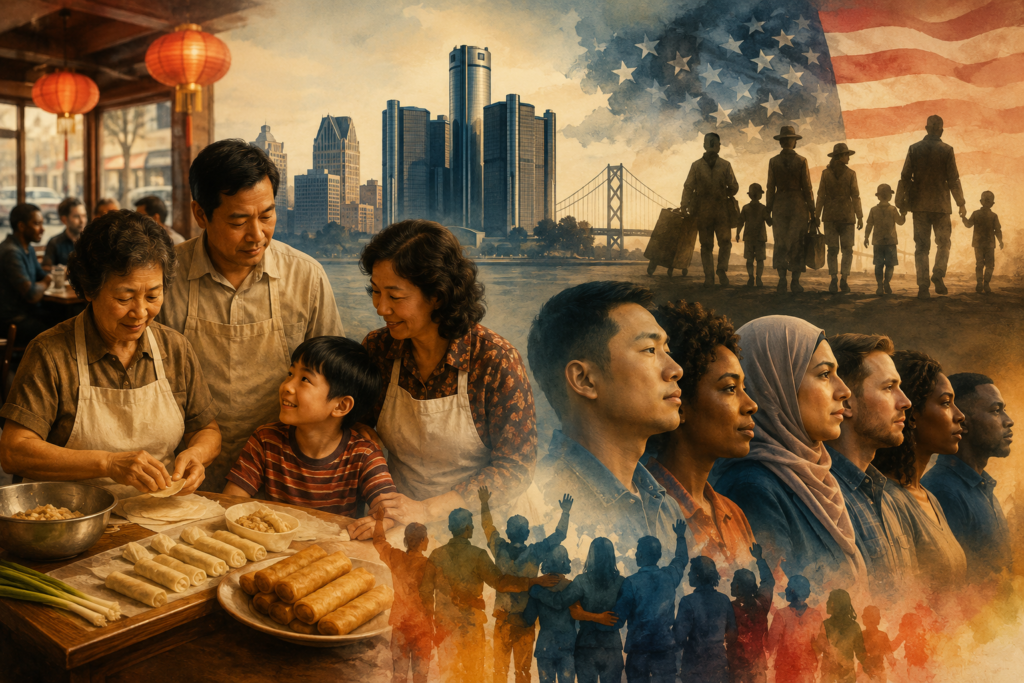
As the United States approaches its 250th anniversary, the question of who gets to belong in America is once again at the center of national debate. During an American Community Media national briefing titled “A Conversation with Author Curtis Chin: Who Gets to Belong in America?” writer, filmmaker and organizer Curtis Chin used his family’s Detroit restaurant story to examine immigration, race, democracy and American identity.
The briefing, held during AAPI Heritage Month, centered on Chin’s memoir, “Everything I Learned, I Learned in a Chinese Restaurant,” a book about growing up Chinese American, gay and working class in 1980s Detroit. Sunita Sohrabji, co-producer of American Community Media’s Friday briefings, introduced the conversation by saying Chin’s memoir “grapples with the questions of how American is defined and who gets to define it.”
That question now reaches far beyond literature. It connects directly to current fights over birthright citizenship, rising hate crimes, anti immigrant policies, denaturalization concerns and the way communities of color are framed in national politics.
Growing Up in Detroit’s Chinese Restaurant
Chin told reporters that his family’s restaurant, Chung’s Cantonese Cuisine, was not just a business. It was a community hub in a city shaped by Black and white racial politics, economic decline, the auto industry crisis and the 1982 murder of Vincent Chin.
“My name is Curtis Chin and I am the author of this memoir, Everything I Learned I Learned in a Chinese Restaurant,” Chin said. “And as the title of the book says, I grew up in a Chinese restaurant. But I like to think of this as not just any Chinese restaurant, but the Chinese restaurant in Detroit.”
He added that his family sold “10 million egg rolls” over 65 years, a detail that became a doorway into a larger American story. For Chin, food, family and work were lessons in survival.
“For me, writing the book is a thank you to my parents for teaching me and my siblings everything we needed to navigate this world,” Chin said. “But it’s also a hat tip to my hometown of Detroit because I think a lot of people still kind of misunderstand the city of Detroit.”
Immigration, Exclusion and the Fight to Belong
Chin traced his family history back to the late 1800s, when his great great grandfather came from China and eventually built a life in Detroit. That history, he said, cannot be separated from the Chinese Exclusion Act, the first major U.S. law to ban a specific ethnic group from immigrating.
“My family succeeded because of America but America also succeeded because of my family,” Chin said, describing one of the central messages of his memoir.
That message lands at a moment when the U.S. Supreme Court is reviewing legal challenges around President Donald Trump’s executive order seeking to restrict birthright citizenship. The case echoes older battles over whether Asian Americans, immigrants and children of immigrants could fully belong in the United States.
Nestor Fantini of HispanicLA.com asked Chin about the birthright citizenship issue. Chin responded plainly: “Do I believe in birthright citizenship? Yes, I do.”
He added, “If you’re born here in the United States, just like if you’re anybody who’s physically in the United States, you have certain rights.”
Vincent Chin and Anti Asian Hate Today
The briefing repeatedly returned to the murder of Vincent Chin, a Chinese American man killed in Detroit in 1982 by two white autoworkers during a period of anti Japanese sentiment tied to the auto industry. Chin said the stereotypes that targeted Asian Americans then remain painfully familiar today.
“The discrimination that my great great grandfather faced when he first arrived here is not so different from these same stereotypes and accusations that I face,” Chin said. “That we are foreigners, that we can’t assimilate.”
Current FBI hate crime data and civil rights analyses show that anti Asian hate remains elevated compared with pre pandemic levels. Chin said the difference between the 1980s and today is that Asian American communities now have stronger civic infrastructure, more journalists, more nonprofits, more elected officials and more public voices.
“We have Asian American journalists in the newsrooms uplifting stories,” Chin said. “We have Asian American politicians. We have Asian American nonprofits that are doing victim advocacy work.”
Race, Class and White Supremacy
Sandy Close, founder of American Community Media, asked Chin how he views interracial relations “at a time when white supremacy is on the rise.” Sohrabji tied the question to recent violence and the continued threat of online radicalization.
Chin said division is often fueled by economic anxiety and exploited by people in power.
“They can bring up race, they can bring up religion, they can bring up sexual orientation, they can bring up all these other things to divide us,” Chin said.
He argued that Americans need to look at the economic forces behind resentment and scapegoating, especially when working class communities are encouraged to blame immigrants, people of color or other minorities for job loss, housing insecurity and lack of opportunity.
What Latino and Immigrant Communities Can Learn
Araceli Martinez of Excelsior California asked what Hispanics can learn from Chin’s book during “times of uncertainty and fear.” Chin said his story is specific to Chinese American Detroit, but the heart of it is universal.
“At the end of the day it really is just a family story,” Chin said. “It’s about a family who’s working together in a family business, trying to help each other, trying to deal with the struggles around us.”
He said many Latino readers have told him the book reminds them of their own families and restaurants. That shared experience, he said, is where communities can build understanding across race and ethnicity.
Who Defines American?
Carlos Roa of Te Lo Cuento News asked what makes a person truly feel they belong in America. Chin answered with a story about an immigrant who had lived in the U.S. for 30 years and still wondered when she could call herself American.
“You’re an American when you want to be an American,” Chin said. “When you don’t give up that right of other people to define what does it mean to be American.”
For Chin, American identity is not handed down by one group, one race or one political movement. It is built by communities living, working, eating, arguing and dreaming together.
A Multicultural Vision of America
Chin said artists and writers have a responsibility to imagine the country they want to see.
“What is the America that we’re writing about?” he asked. “What is the vision of America that we’re putting out there for people to embrace?”
His answer is rooted in the Chinese restaurant where he grew up, a place where people from different races, religions and backgrounds could sit near each other and share a meal.
“Come for the egg rolls, but stay for the talk on racism,” Chin joked.
At a time when citizenship, immigration and racial belonging are again being contested, Chin’s story offers a reminder that America has always been shaped by families who were told they did not belong, then helped build the country anyway.
Curtis Chin plantea quién tiene derecho a pertenecer en Estados Unidos durante una reunión informativa por el Mes de la Herencia AAPI
Una conversación oportuna sobre identidad, raza e inmigración
Mientras Estados Unidos se acerca a su aniversario número 250, la pregunta de quién tiene derecho a pertenecer en el país vuelve a ocupar el centro del debate nacional. Durante una reunión informativa nacional de American Community Media titulada “Una conversación con el autor Curtis Chin: ¿Quién tiene derecho a pertenecer en Estados Unidos?”, el escritor, cineasta y organizador Curtis Chin usó la historia del restaurante de su familia en Detroit para reflexionar sobre inmigración, raza, democracia e identidad estadounidense.
La reunión, realizada durante el Mes de la Herencia de los Asiático Americanos e Isleños del Pacífico, se centró en las memorias de Chin, “Everything I Learned, I Learned in a Chinese Restaurant”, un libro sobre crecer como chino estadounidense, gay y de clase trabajadora en Detroit durante la década de 1980. Sunita Sohrabji, coproductora de las reuniones informativas de los viernes de American Community Media, presentó la conversación diciendo que las memorias de Chin “abordan las preguntas de cómo se define lo estadounidense y quién tiene derecho a definirlo”.
Esa pregunta ahora va mucho más allá de la literatura. Se conecta directamente con debates actuales sobre la ciudadanía por nacimiento, el aumento de crímenes de odio, las políticas antiinmigrantes, las preocupaciones sobre la desnacionalización y la forma en que las comunidades de color son representadas en la política nacional.
Crecer en un restaurante chino de Detroit
Chin dijo a los periodistas que el restaurante de su familia, Chung’s Cantonese Cuisine, no era solamente un negocio. Era un punto de encuentro comunitario en una ciudad marcada por la política racial entre comunidades negras y blancas, el declive económico, la crisis de la industria automotriz y el asesinato de Vincent Chin en 1982.
“Mi nombre es Curtis Chin y soy el autor de estas memorias, Everything I Learned I Learned in a Chinese Restaurant”, dijo Chin. “Y como dice el título del libro, crecí en un restaurante chino. Pero me gusta pensar que no era cualquier restaurante chino, sino el restaurante chino en Detroit”.
Agregó que su familia vendió “10 millones de egg rolls” durante 65 años, un detalle que abrió la puerta a una historia estadounidense más amplia. Para Chin, la comida, la familia y el trabajo fueron lecciones de supervivencia.
“Para mí, escribir el libro es una forma de agradecer a mis padres por enseñarme a mí y a mis hermanos todo lo que necesitábamos para navegar este mundo”, dijo Chin. “Pero también es un reconocimiento a mi ciudad natal, Detroit, porque creo que muchas personas todavía malentienden la ciudad de Detroit”.
Inmigración, exclusión y la lucha por pertenecer
Chin rastreó la historia de su familia hasta finales del siglo XIX, cuando su tatarabuelo llegó desde China y eventualmente construyó una vida en Detroit. Esa historia, dijo, no puede separarse de la Ley de Exclusión China, la primera ley importante de Estados Unidos que prohibió la inmigración de un grupo étnico específico.
“Mi familia tuvo éxito gracias a Estados Unidos, pero Estados Unidos también tuvo éxito gracias a mi familia”, dijo Chin, describiendo uno de los mensajes centrales de sus memorias.
Ese mensaje llega en un momento en que la Corte Suprema de Estados Unidos revisa desafíos legales relacionados con una orden ejecutiva del presidente Donald Trump que busca restringir la ciudadanía por nacimiento. El caso recuerda luchas anteriores sobre si los asiático estadounidenses, los inmigrantes y los hijos de inmigrantes podían pertenecer plenamente a Estados Unidos.
Nestor Fantini de HispanicLA.com preguntó a Chin sobre el tema de la ciudadanía por nacimiento. Chin respondió de forma clara: “¿Creo en la ciudadanía por nacimiento? Sí, creo”.
Agregó: “Si naces aquí en Estados Unidos, al igual que cualquier persona que esté físicamente en Estados Unidos, tienes ciertos derechos”.
Vincent Chin y el odio anti asiático actual
La reunión volvió en varias ocasiones al asesinato de Vincent Chin, un hombre chino estadounidense asesinado en Detroit en 1982 por dos trabajadores blancos de la industria automotriz durante un periodo de sentimiento anti japonés relacionado con la industria automotriz. Chin dijo que los estereotipos que atacaban a los asiático estadounidenses en ese entonces siguen siendo dolorosamente familiares hoy.
“La discriminación que enfrentó mi tatarabuelo cuando llegó aquí por primera vez no es tan diferente de estos mismos estereotipos y acusaciones que yo enfrento”, dijo Chin. “Que somos extranjeros, que no podemos asimilarnos”.
Datos actuales del FBI sobre crímenes de odio y análisis de derechos civiles muestran que el odio anti asiático sigue elevado en comparación con los niveles previos a la pandemia. Chin dijo que la diferencia entre la década de 1980 y hoy es que las comunidades asiático estadounidenses ahora cuentan con una infraestructura cívica más fuerte, más periodistas, más organizaciones sin fines de lucro, más funcionarios electos y más voces públicas.
“Tenemos periodistas asiático estadounidenses en las salas de redacción elevando historias”, dijo Chin. “Tenemos políticos asiático estadounidenses. Tenemos organizaciones sin fines de lucro asiático estadounidenses que hacen trabajo de defensa para las víctimas”.
Raza, clase y supremacía blanca
Sandy Close, fundadora de American Community Media, preguntó a Chin cómo ve las relaciones interraciales “en un momento en que la supremacía blanca está en aumento”. Sohrabji conectó la pregunta con la violencia reciente y la amenaza continua de la radicalización en línea.
Chin dijo que la división muchas veces es alimentada por la ansiedad económica y aprovechada por personas en el poder.
“Pueden sacar el tema de la raza, pueden sacar el tema de la religión, pueden sacar el tema de la orientación sexual, pueden sacar todos estos otros temas para dividirnos”, dijo Chin.
Argumentó que los estadounidenses deben mirar las fuerzas económicas detrás del resentimiento y la búsqueda de chivos expiatorios, especialmente cuando se anima a las comunidades trabajadoras a culpar a inmigrantes, personas de color u otras minorías por la pérdida de empleos, la inseguridad de vivienda y la falta de oportunidades.
Lo que las comunidades latinas e inmigrantes pueden aprender
Araceli Martínez de Excelsior California preguntó qué pueden aprender los hispanos del libro de Chin durante “tiempos de incertidumbre y miedo”. Chin dijo que su historia es específica de la experiencia chino estadounidense en Detroit, pero que el corazón de la historia es universal.
“Al final del día, realmente es solo una historia familiar”, dijo Chin. “Es sobre una familia que trabaja junta en un negocio familiar, tratando de ayudarse unos a otros, tratando de enfrentar las luchas a su alrededor”.
Dijo que muchos lectores latinos le han comentado que el libro les recuerda a sus propias familias y restaurantes. Esa experiencia compartida, dijo, es donde las comunidades pueden construir entendimiento a través de raza y etnicidad.
¿Quién define lo estadounidense?
Carlos Roa de Te Lo Cuento News preguntó qué hace que una persona realmente sienta que pertenece a Estados Unidos. Chin respondió con una historia sobre una inmigrante que había vivido en Estados Unidos durante 30 años y todavía se preguntaba cuándo podía llamarse estadounidense.
“Eres estadounidense cuando quieres ser estadounidense”, dijo Chin. “Cuando no renuncias a ese derecho de que otras personas definan qué significa ser estadounidense”.
Para Chin, la identidad estadounidense no es otorgada por un solo grupo, una sola raza o un solo movimiento político. Se construye por comunidades que viven, trabajan, comen, discuten y sueñan juntas.
Una visión multicultural de Estados Unidos
Chin dijo que artistas y escritores tienen la responsabilidad de imaginar el país que quieren ver.
“¿Cuál es el Estados Unidos sobre el que estamos escribiendo?”, preguntó. “¿Cuál es la visión de Estados Unidos que estamos poniendo ahí afuera para que la gente la abrace?”
Su respuesta está arraigada en el restaurante chino donde creció, un lugar donde personas de diferentes razas, religiones y orígenes podían sentarse cerca unas de otras y compartir una comida.
“Vengan por los egg rolls, pero quédense por la conversación sobre el racismo”, bromeó Chin.
En un momento en que la ciudadanía, la inmigración y la pertenencia racial vuelven a ser disputadas, la historia de Chin ofrece un recordatorio de que Estados Unidos siempre ha sido formado por familias a quienes se les dijo que no pertenecían, pero que aun así ayudaron a construir el país.
About The Author



More Stories
Houston Text Fest 2026: A Community’s Stories Come Together (Photo Gallery)
2026 Midterm Voting Barriers: What Ethnic Communities Need to Know
Supreme Court Mail-In Voting Ruling: What It Means for the 2026 Midterms